Editor's Choice
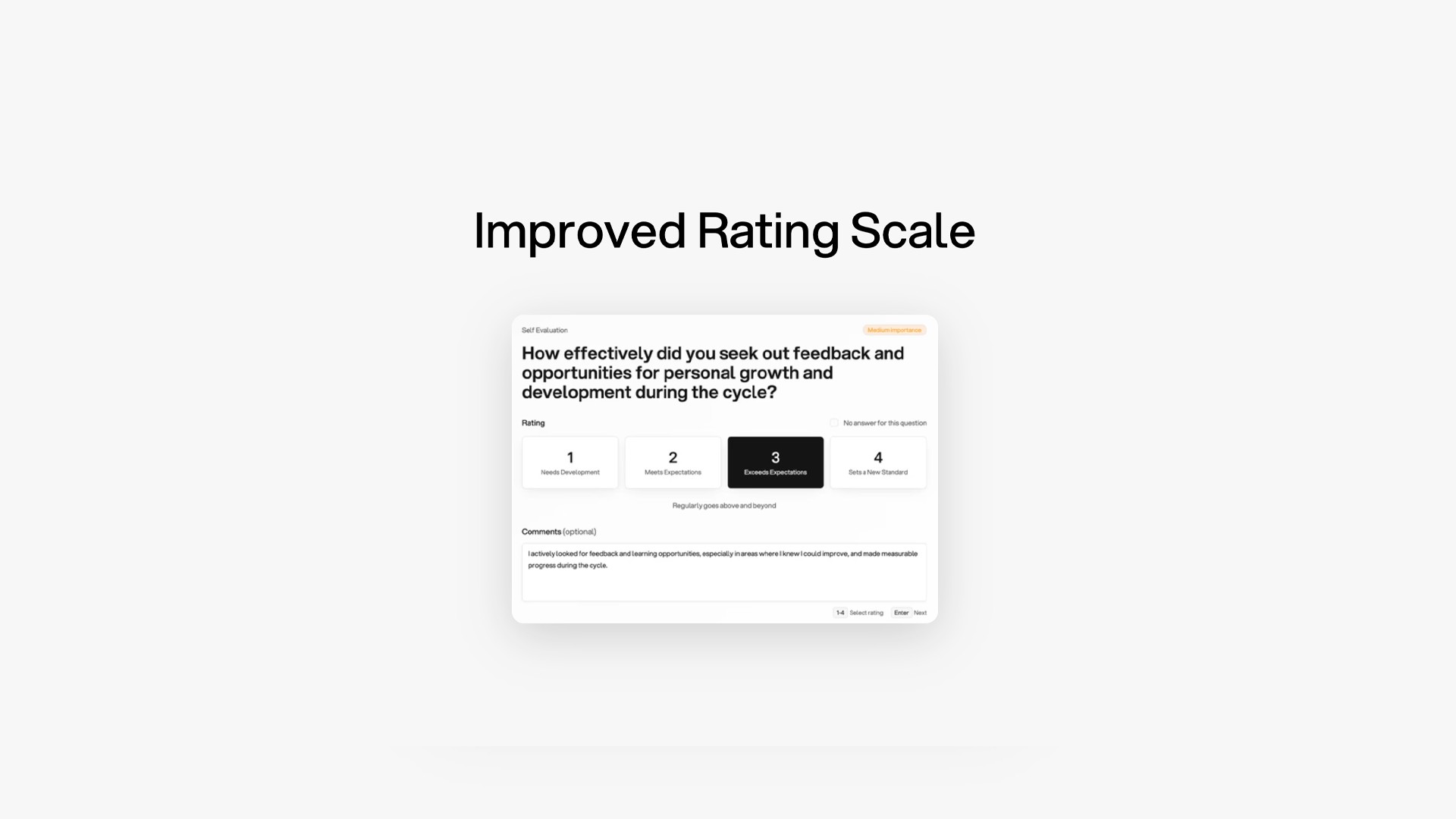
Introducing Improved Rating Scale
Evaluation ratings just got a lot more meaningful. We've updated the rating scale across all Baxo evaluations to make scores clearer, more consistent, and more useful for both the people giving feedback and the people receiving it.
The old rating system used numbers, but numbers alone don't tell a story. A 3 out of 5 means something different to every person who gives it. Without shared definitions, scores become inconsistent across evaluators, and the resulting data loses much of its value. When you're trying to synthesize feedback from self-evaluations, peer reviews, and manager assessments into a single coherent picture of performance, inconsistency in how people interpret the scale is a serious problem.
The improved rating scale solves this by giving every number a name and every name a definition.
1 — Needs Development: Performance in this area falls below expectations and requires focused attention and improvement.
2 — Meets Expectations: Performance is solid and consistent. This person is reliably delivering what's expected of them in this area.
3 — Exceeds Expectations: Performance regularly goes above and beyond. This person isn't just meeting the bar — they're raising it.
4 — Sets a New Standard: Performance in this area is exceptional and sets the benchmark for what great looks like on the team.
Each rating also includes a short contextual description that appears below the selected score during an evaluation, reinforcing what the rating means in the moment of selection rather than requiring evaluators to remember definitions from a rubric they read once.
A "No answer for this question" option is now available for every evaluation question. Sometimes a peer genuinely doesn't have enough visibility into a particular area to provide a meaningful rating. Rather than forcing a guess that skews the data, evaluators can now indicate that honestly — keeping results clean and trustworthy.
Importance tags appear on each question to show evaluators which areas the cycle is prioritizing. Questions marked as High Importance carry more weight in the overall analysis, and seeing that label helps evaluators understand where to invest their attention and be most thoughtful.
The comment field is available on every question, allowing evaluators to add written context to any rating they give. Comments are optional, but they're where some of the most valuable feedback lives — the specific examples and observations that turn a number into actionable insight.
Keyboard-friendly navigation lets evaluators move through questions quickly using number keys to select ratings and Enter to advance, making the evaluation experience faster and more fluid for people who prefer not to use a mouse.
A well-designed rating scale is one of the most foundational elements of effective performance management. When evaluators share a common language for what scores mean, the data becomes more reliable, comparisons across team members become more valid, and the AI-generated reports Baxo produces become significantly more accurate and actionable. This update is an investment in the quality of every evaluation that runs on the platform going forward.